Rebuilding the core flow
The starting point
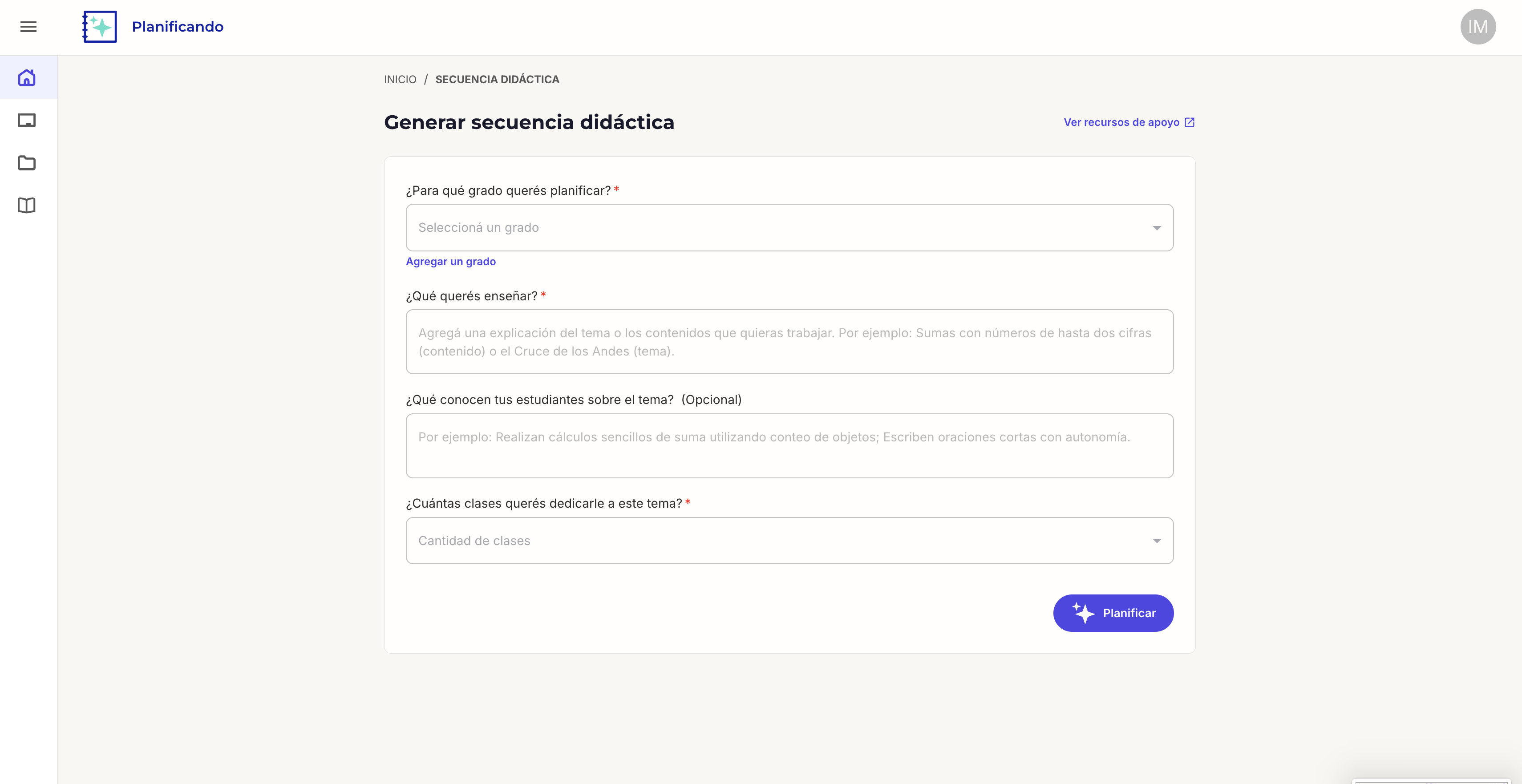
V1 was a form. The teacher selected a grade, described the topic, retyped what her students knew, picked a class count from a bare dropdown, and waited about 30 seconds for a document. Every generation started from zero. The plan list filled with near-duplicates: the one way to iterate on a plan, a "Regenerar" action, went mostly undiscovered, so teachers generated again instead.
Decision 1 · The grade became the workspace
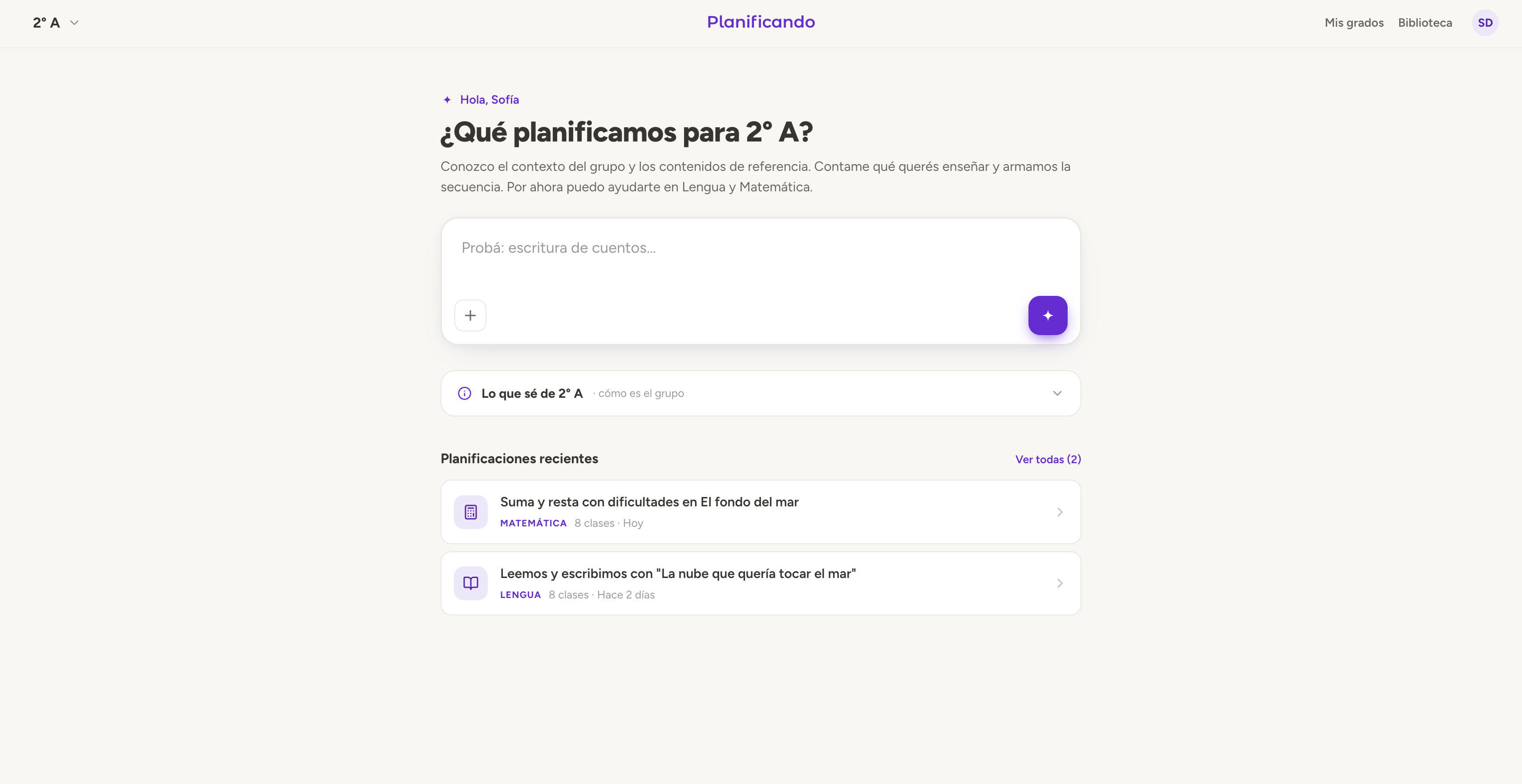
V1 organized the app around the generator: grades, plans and texts were parallel menu sections. In V2 each grade is a space. The home screen is the grade, plans live inside it, and the app opens where the teacher works.
The pedagogical team wanted the opposite: a grade picker as the landing screen, on the reasoning that a teacher should choose her group before anything else. It is a defensible model and it is how the curriculum is organized.
The distribution argued against it. Of the teachers with an active grade, 82% have exactly one. A picker would be a screen most teachers pass through with a single option on it.
What made the argument was not the average. Counting everyone, including our own team holding dozens of test grades, the figure is ambiguous enough for the picker to win. Excluding the team, it is not close. The decision turned on segmenting the data, not on having it.
Decision 2 · Context became something the product keeps
V1 asked "¿Qué conocen tus estudiantes sobre el tema?" on every generation and discarded the answer. V2 stores a description of the group per grade — free text, in the teacher's words — and uses it for every plan. The empty state says why it's worth loading: "para que cada planificación salga a la medida."
I knew the field wasn't working because I had built a way to look at it. In V1's admin console I added a view of what teachers were actually typing there, next to the plans themselves — not to report on it, but to understand what a field called "context" was being used for.
One question in particular was doing the damage. "What do you want to teach?" accepted either a topic or a curricular content — its own placeholder offered both as examples — so teachers answered with whichever half they had in mind: some wrote the topic and left the content out, others the reverse. A half-answered request made it harder to keep the output relevant, and sometimes it did not pass validation at all.
V2 splits that question in two, each named in the words a teacher uses: the thematic universe the grade is working in, and what she wants to teach now.
Decision 3 · The system proposes, the teacher adjusts
V1 asked for a class count before showing anything. V2 inverts it: before generating, a review screen shows what the system understood (group, subject, topic, text) and recommends a class count the teacher can move on a slider. The same inversion drives the Lengua flow: instead of a 39-text library to browse, the system suggests two texts matched to the request, with the option to paste your own.
Decision 4 · Iteration moved inside the document
V1 had a separate edit mode, and its one way to ask for changes — a "Regenerar" action — went mostly undiscovered, so in practice iterating meant generating again, which is why the plan list filled with near-duplicates. In V2 the plan is editable in place, and a "¿Qué cambiamos?" panel takes change requests, with suggested changes as chips so the teacher learns what kinds of adjustments are possible.
Whether it displaced regeneration, I can't say yet: the panel fires a single event with no properties, so the data can't separate a change request from a regeneration. An instrumentation gap of my own making, first on the list to fix.
Decision 5 · The wait became where context gets captured
Decision 2 gave the product a place to keep context. It did not make teachers write it: in the version we tested in schools, six of seven plans left the context field blank. It was the last thing between the teacher and the result she came for, so she skipped it.
The obvious fix is better microcopy, or examples, or a friendlier placeholder. I moved the question instead.
Generating a plan takes close to a minute, and the teacher spends it watching a progress bar. So the question appears there now, one at a time, with three options and a free-text field. The screen states that the answer will not change the plan being generated: it feeds the group's context, which is what the next plan reads from. Answering is optional, the plan can arrive mid-question, and answered questions do not repeat.
45 teachers answered at least one question, with a median of 5 answers each.
How the waiting screen was explored
V1 showed a checklist and a progress bar. The exploration compared combinable variants: streaming the plan as it writes, tips, curriculum grounding, skeleton screens, personalization signals. What shipped kept the progress bar and turned the wait into the place where the product asks for context.
Status
V2 is live at v2.planificando.tech and has been instrumented since 11 August 2026. The first measured window covers 18 days: 82 new accounts, 64 created a grade, 51 generated a plan, 28 exported one.
Adoption is concentrated: one institutional agreement accounts for most of the use.
Auditing the numbers to write this case, I was not convinced by their rigor, and the instrumentation needs a proper review. What follows are the observations I would still stand behind.
One of them points somewhere I did not expect: 92% of plans start from a topic the teacher typed, not one picked from the indexed curriculum. We index the curriculum and wrote 488 short classroom-language phrases from it, and teachers still write their own. That is the next problem.
The comparison with V1 is answerable after all, but only off the funnel. Anchored in cohorts of new signups rather than in events, activation within seven days went from 33% to 43%, and the share of teachers who planned again on a different day went from 15% to 49%. Nothing else compares: the events changed meaning between versions, so a raw reading of anything else measures the instrument rather than the product.
Whether the accumulated context makes the next plan better is the question the whole redesign rests on, and it is still open.